
SW1X Revisited, Now with MTR 963 Loudspeakers: Single-Driver Monitor Behind an SE 300B
(Translated from original article in Dutch)
René van Es | February 23, 2026
Live Fidelity, represented by Armin Bos, always has something special to offer. Not because it has to be different, nor to attract attention, but because he has a talent for finding audio equipment that approaches reality as closely as possible. Previously with Bastanis open baffles, electronics by Slawa Roschkow, and this time even loudspeakers from Slawa’s own company, SW1X.
The setup had already been seen and heard at the 2025 Dutch Audio Event, but now I had the opportunity to listen to a complete SW1X system in peace and quiet, without the sound bleed from neighboring exhibitors. Comfortably seated, iPad within reach, laptop open for taking notes, and later some photos to shoot. Life hardly gets more enjoyable for a music lover like myself.
SW1X
SW1X as a company has only one goal: reproducing recorded music in the most natural way possible, whether through analog means or digital streaming. SW1X does not follow fashion trends, does not care about flashy looks, and is entirely focused on functional, timeless designs that always serve the music. To achieve this, SW1X develops its own circuits, designs its own equipment, and manufactures its products in-house.
The mastermind behind the company—whose full name is Slawa Roschkow One X—is Slawa Roschkow, an audio genius born in Russia and now living in England, long before Putin came to power. SW1X is best known for electronics in which vacuum tubes handle as many tasks as possible and semiconductors as few as possible. Think amplification, rectification, and even clock regulation in a DAC or network transport.
SW1X offers customers different levels of construction quality. Transformers, chokes, and interstage transformers can be wound with copper, copper-and-silver, or pure silver. Capacitors, resistors, and wiring follow the same hierarchy. Naturally, each level comes with a different price tag—silver alone is far from cheap.
SW1X MTR 963
SW1X now also offers loudspeakers. And, unsurprisingly, these too differ from what is generally considered “normal” in audio. The lineup consists of two horn systems and one monitor speaker, the latter being the MTR 963 standing before me.
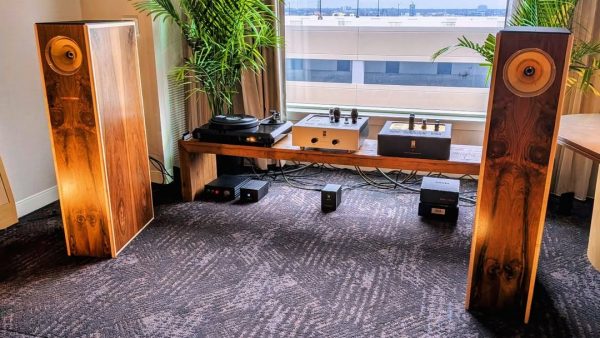
 It has an old-school cabinet shape: much taller and wider than it is deep, ideal for proper dispersion characteristics. Inside is only a single driver, supported by a slot-shaped bass reflex port on the baffle. The MTR 963 is designed to be driven by a low-powered tube amplifier, for example a single-ended 300B, though I suspect EL84 or even EL34 push-pull amplifiers would also produce astonishing results.
The MTR 963 was developed as a home loudspeaker—musical in every sense of the word, whatever that means to you—with coherent behavior across the entire frequency range. SW1X achieves this by using only one driver per cabinet.
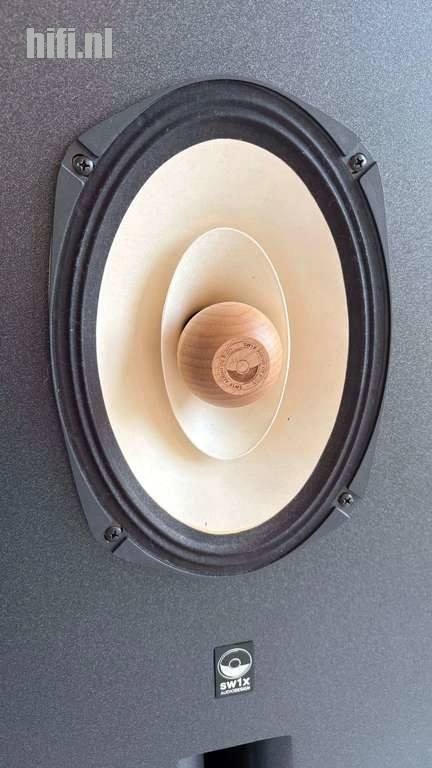
The driver is an oval-shaped paper dual-cone unit with a wooden phase plug mounted in the center. The cone uses a textile surround. The large cone measures 9 inches, the secondary cone 6 inches, and the “whizzer” cone for the highs is 3 inches. Hence the name MTR 963.
The driver is available in two versions: with an AlNiCo magnet, as used here at Live Fidelity, or as a Field Coil version with adjustable tube power supplies. I could practically hear audiophiles drooling at the thought. With only one driver, the MTR 963 is an ideal point source with phase-coherent behavior.
The MTR 963 is intended as a nearfield and/or midfield monitor, performing best in small to medium-sized listening rooms. In larger spaces they can still work well when placed in room corners. Bass extends down to 35 Hz, though for the deepest bass notes proper amplifier matching and careful placement are essential.
For truly large spaces, SW1X recommends stepping up to their smallest horn system, the XCalibur, which uses the same mid/high driver family. “Small” is relative here—the XCalibur weighs 150 kg per speaker.
None of the SW1X loudspeakers use a crossover. Whatever signal the amplifier outputs goes directly to the MTR 963 driver. The driver presents no difficult load to the amplifier, which is essential when a 300B tube is considered the ideal match.
The cabinet is built from 35 mm thick piano-grade plywood, including the bass reflex port, which is hand-finished. No screws are used in cabinet construction, except the four mounting screws for the driver itself. The cabinets are finished in real veneer with satin rosewood lacquer, though other finishes are available upon request.
Cabinet damping consists of real sheep’s wool. Internal wiring uses SW1X Magnum, Genesis, or Opus copper cable, with silver available on request.
The MTR 963 is intended to stand on specially designed black stainless steel stands, fillable with sand. The stands rest on Panzerholz bases or spikes. Each speaker measures 70 × 50 × 30 cm, with a total height of 110 cm on the stands.
Each MTR 963 weighs 45 kg without the stand, giving an indication of how solidly built they are. Technically, the speakers can already work with amplifiers delivering just 3 watts per channel. Sensitivity is 94 dB with the AlNiCo magnet and 96 dB with the Field Coil version. Minimum impedance is 8 ohms, and frequency response is specified as 35 Hz to 20 kHz, though SW1X does not specify tolerance limits.
SW1X Electronics, Cables, and Vortex
 Live Fidelity assembled an extensive system using SW1X electronics. It starts with the VDT II Valve Digital Transport. Inside the transport, semiconductors are minimized as much as possible. Tubes are used to achieve an analog sonic character that SW1X believes grainy, harsh, and hard-sounding transistors cannot match.
Of course, tubes cannot handle the streaming module itself, but they are used for the clock signal, the output stage, and rectification. Music arriving from a NAS or streaming service is buffered as little as possible and passes through as few circuits as possible, aiming for the immediacy of CD playback. According to SW1X, this minimizes timing errors, signal degradation, and additional noise.
The internal computer in the VDT II runs Linux for streaming and is tube-powered for optimal performance.
The signal then moves to a DAC III Balanced D/A converter using the legendary TDA1541 chip. The TDA1541 employs a mechanism known as DEM—Dynamic Element Matching—which continuously reallocates current sources to the six most significant bits. This results in cleaner digital-to-analog conversion and a more organic presentation.
Normally, this process occurs internally within the TDA1541 chip, but SW1X controls it using an external tube-based oscillator. The DAC contains three power supplies and a tube output stage.
No oversampling is used, and there is no digital filter. The DAC III Balanced uses transformer output coupling with EL84 tubes. I/V conversion is handled through a resistor directly coupled to the tube grid via the shortest possible signal path; from DAC III level and upward, I/V conversion becomes active. Decoupling capacitors are Black Gates, while resistors are Allen Bradley carbon-film types.
Because of the TDA1541 chip, the maximum supported sample rate is 96/24, although internally the converter works with the first 16 bits.

PRE III and AMP V Titan
As a line stage, a SW1X PRE III Special Edition with optional headphone output was used. A phono stage can also be installed in this preamp.
The PRE III uses no feedback whatsoever—neither local nor global—and transformer-couples its output. Besides a 6N6P driver tube (or equivalent), it uses two EL84 output tubes and tube rectification with CLC2LC chokes.
The amplifier is hardwired with SW1X solid-core and/or litz wire. Volume is controlled by 24-step attenuators using discrete resistors. It is dual mono, meaning each channel has its own knob.
There is no remote control, deliberately omitted to avoid digital interference—so you have to get up every now and then, which is supposedly good for circulation.
 Finally we arrive at the SW1X AMP V Titan single-ended tube amplifier, using one 300B output tube per channel—in this case from PSvane. Other tubes include 6SN7 drivers and either a 5AS4 or 5U4G rectifier.
Technically this is an integrated amplifier, though here it is used as a power amplifier. The AMP V employs no feedback and naturally operates in pure Class A with directly heated triodes.
Internally it uses point-to-point wiring with SW1X cable. Only three amplification stages are required from input to output, using transformers wound to SW1X specifications. In this case, the Special version with copper wire on a HiB DC core.
Its “generous” output power is 7 watts per channel—enough for the MTR 963.
All cables in the system are also from SW1X: power cords, interconnects, and speaker cables using OFC litz conductors. From source to speaker, this is a complete SW1X system.
Under the electronics sit Vortex feet, while various Vortex antennas and discs can also be seen attached to some transformers and components.
Listening from NAS and Qobuz
Let’s start with something challenging: Vox Feminae by Les Kapsber’Girls, featuring two or three classical female vocalists performing works accompanied by lute, viola da gamba, and other string instruments.
The voices occupy precise positions in space, remaining separate individuals in the stereo image rather than blending together except where intended by the music. The soundstage stretches beautifully from left to right, detached from the loudspeakers themselves, which genuinely behave like point sources.
The voices are extremely pure. These speakers emphasize the midrange. Treble can occasionally sound slightly ragged, though this clearly stems from the recording rather than the speakers themselves.
Armin tells me that Slawa Roschkow strongly dislikes streaming services and disapproves of their quality. Armin himself also prefers playing music from a local NAS.
Bass is calm, controlled, and present. The small woofer does not move massive quantities of air—but controlled and clean bass is preferable to overwhelming and ultimately fatiguing bass.
This is a system you can listen to for hours, as proven by the number of tracks I played from this album. Pay attention too to the purity with which plucked instruments strike the eardrum. Beautiful music on an equally beautiful system.
 It’s Peter Wispelwey’s turn with Bach’s cello suites. What makes the reproduction special is the sense of space and air surrounding the solo instrument. Admittedly, it does require walking a few meters every time to adjust the volume between albums—the purist line stage has no remote control whatsoever—but I suppose that keeps you young.
Peter’s cello, large and imposing, appears at some distance. To my brain, it is not in this room at all, but rather in a recreated, much larger acoustic space. The reproduction virtually takes over the listening room and creates a new one. I find that quite impressive—the ability to generate such an illusion. In this way, Peter seems to stand some six or seven meters away from me, while the speakers themselves are only 2.5 to 3 meters distant. The performance therefore feels far more natural than if Peter were standing directly in front of your nose.
The nuances in the cello’s sound are easy to follow and distinguish. What are the strings doing? What is the body of the instrument contributing? What role does the bow play? From a file stored somewhere in the Cloud, SW1X creates a new reality and astonishes with this classical performance by a true cello master.
Bach on Piano
Another solo instrument—one that presents a real challenge for any loudspeaker. A grand piano under the fingers of Glenn Gould, once again Bach, this time The Goldberg Variations. Unfortunately, it is a remastered version, which never excites me very much. I would rather hear the original, but Qobuz doesn’t cooperate in that regard.
Played on a Steinway CD 19, the sound is concise and, in this remaster, occasionally resembles a harpsichord more than a grand piano. The performance itself is direct and pure, rich in dynamics that were exceptionally well captured in Gould’s era. The album has always been a commercial success, which is hardly surprising if you are a Bach enthusiast.
A grand piano under the hands of Khatia Buniatishvili has a much softer tone. The treble remains sufficiently clear, but now combines with a warm glow in the lower registers. Her album Motherland is more or less a permanent fixture in my playlist. An intermezzo by Johannes Brahms is a joy to listen to—especially as I become increasingly accustomed to the presentation of the SW1X MTR 963 loudspeaker.
At first the sound struck me as somewhat unusual, but gradually I began to recognize its quality. I stopped listening to hi-fi and simply followed the music.
Note after note rolls toward me, controlled and tight, without peaks or resonances. Every note played by the left hand remains distinct from those of the right. From soft and tender to fierce and exhilarating, everything is presented grandly. Closer than Wispelwey’s cello, the piano stands somewhere between the two speakers, slightly farther back, with a sense of spaciousness behind it in which the performance can release its energy. Rather than a confined recording space, the MTR 963 transforms the setting into a large studio.
Old Dire Straits material, “Planet of New Orleans,” demonstrates just how enormous the stereo image can become with the SW1X loudspeakers—stretching meters wide before shrinking after the intro into an intimate setting, then swelling again, packed with detail. I had never realized how much percussion exists in this track.
 Everything occupies its own place within the three-dimensional stereo image. The small driver cannot produce the punch and slam of a larger system with 30 cm woofers, but the SW1X does its utmost to create the illusion of a substantial multi-way system. It does so with precision, making listening not only enjoyable but continually engaging.
The sound is simply satisfying—a little rough around the edges in a way that suits pop music, yet clear and transparent. Perhaps it is sacrilege in the church of SW1X, but I suspect a pair of woofers in a bass horn could perform miracles. Conventional subwoofers may struggle to keep up. The question is whether they can match the speed of these speakers, because fast they certainly are. For greater slam, SW1X combines a driver from the same family in field-coil form with a front-loaded bass horn.
Dutch Audio Event
Alison Krauss finally returned to the studio with her band Union Station. The result is the album Arcadia, which places Alison back on her throne in classic fashion. Naturally, there are plenty of string instruments involved, with bass and percussion supporting her voice.
Alison stands in the foreground of the soundstage, detached from the background, which fills the room broadly and vertically. Once again, the image is positioned between the loudspeakers, curving outward at the edges so that instruments on the left and right appear slightly forward.
From Alison we move to a male voice accompanied by guitar—a combination for which the SW1X MTR 963 seems almost purpose-built. Exceptionally realistic, and here too the speed of the loudspeaker is crucial in approaching reality, just as its point-source behavior is.
The SW1X continues to surprise me positively time after time. It should, considering the total cost of this system, containing twenty-four chokes and/or transformers and an equal number of vacuum tubes spread across four components. Complexity has its price. Tube rectification and interstage transformers do as well, while in the end only two 300B tubes actually provide power to the loudspeakers.
The elaborate construction was not chosen without reason, as becomes obvious when listening to the final result. Every component has been deliberately selected, hand-placed, and soldered onto specially chosen circuit materials that vary depending on the SW1X performance level.
Anyone who visited the most recent Dutch Audio Event and entered the Live Fidelity room may have heard Allan Taylor’s The Beat Hotel playing from their playlist. Clearly not a random choice.
 His deep voice is perfectly intelligible, details travel from ear to ear, and the bass is present yet never exaggerated, free from bass-reflex peaks or dips. Music does not need to be played loudly to sound complete; even at a pleasant listening level over which conversation remains easy, it still caresses the ears.
Winter Songs by Terje Isungset sounds suspenseful and mystical, with bright tones and soft vocals. Do not expect subterranean bass—that remains reserved for systems with large woofers. The imaging with Terje on the SW1X loudspeakers is astonishing. Rarely does something receive such a fixed and defined position within a stereo image. You could walk toward each struck icicle and point directly at it.
“The Sound of Silence” may be a strange title in the context of a review, but Paul Simon live in New York remains deeply impressive. Including microphone pops, audience sounds at a distance from Paul and his guitar—the performance is gripping and immersive, intimate and tangible despite the large acoustic space.
What I ultimately take away from this session is “fever,” as Ray Charles sings together with Natalie Cole. Their duet would warm any heart. Charles’ storytelling vocal delivery is complemented by Cole’s sharper, more dominant edge. Finger snaps are crystal-clear and sharply defined. Their voices sit close together, just as you would imagine two people genuinely enjoying a shared performance.
A beautiful conclusion to a delightful and often surprising listening session.
Something Different
As I mentioned at the beginning, Armin Bos of Live Fidelity does not pursue mainstream audio. He carefully curates his offerings, searching for hidden gems and steering many music lovers toward music itself rather than merely toward technology.
A small side note: the covers had been removed from all SW1X components, so I still ended up staring at a great deal of technology. From the moment I first heard the SW1X MTR 963 monitor at the Dutch Audio Event, I became curious about what this monitor could achieve in a dedicated listening room.

The visit turned out to be a surprising one. On the one hand because the MTR 963 is so fundamentally different from 99 percent of the loudspeakers most of us know—two-way, three-way, or even more elaborate designs, but almost never a single-driver speaker with a dual-cone unit. As a result, it also sounds different, requiring some adjustment on my part.
On the other hand, the MTR 963 can truly captivate you if the concept appeals to you. Take, for example, the projection of music into space—absurdly precise when the recording itself contains that information. Tangible, almost physically present, as though you could walk toward an instrument.
Its limitations appear mainly in the lower frequencies within a room as large as Live Fidelity’s. Yet that is hardly a serious issue, since few instruments extend below roughly 80 Hz anyway. The midrange is tight and open, filling the room and drawing you deeply into the music. The treble is neutral, though unforgiving when a stream or recording reveals flaws.
The result is a complete sonic picture that will linger in my ears and mind for a long time.
SW1X is a small, purely artisanal company that many people likely still do not know. SW1X products are expensive, but Slawa Roschkow certainly knows how to bring music to life with tubes and single-driver loudspeakers.
Live Fidelity High-End Audio Showroom
Mitch Leighhof 2, Utrecht
http://www.livefidelity.nl
Join the official SW1X Audio Club